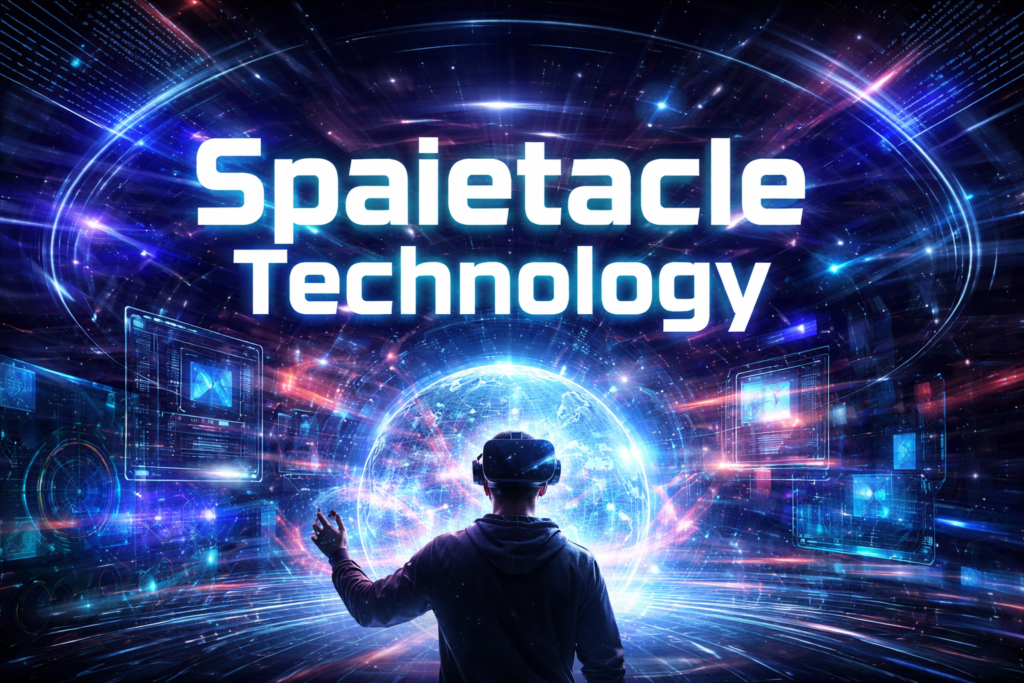

Technology is changing how people use digital systems. In the past users worked with screens buttons and menus. Today users want experiences that feel real interactive and immersive. This change has led to a new technology concept called spaietacle. Spaietacle is about building digital environments that surround the user. These environments respond to movement actions and data in real time. Instead of using a flat screen the user enters a digital space. This space reacts and changes based on what the user does RWU UAR
it is not one device or one software. It is a way to design technology. It combines immersive visuals spatial computing artificial intelligence and real time interaction. The goal is to create digital experiences that feel alive and responsive.
What Is Spaietacle in Technology
It is a technology framework used to create immersive digital environments. These environments are designed to respond to the user in real time.
A spaietacle system does the following
-
It places digital content inside a three dimensional space
-
It tracks user movement and actions
-
It changes based on data and behavior
-
It creates a feeling of presence inside the system
this systems are not passive. They do not show fixed content. They respond continuously. In simple terms spaietacle turns technology into an experience instead of a tool.
Main Features of Spaietacle Technology
This systems share common technical features.
Spatial Experience
Digital content exists in space instead of on screens.
This means
-
Objects have position and depth
-
Content stays in place when the user moves
-
The system understands distance and direction
This creates a sense of presence.
Real Time Response
This systems react instantly.
They respond to
-
Movement
-
Gestures
-
Voice
-
Data changes
Fast response is required to keep the experience smooth.
Adaptive Behavior
This systems change based on the user.
This includes
-
Adjusting visuals
-
Changing system behavior
-
Responding to user patterns
This is often powered by artificial intelligence.
Multi Sensory Output
This systems use more than visuals.
They may include
-
Spatial sound
-
Motion feedback
-
Touch feedback
This helps the user feel inside the environment.
Technology Architecture of This
This systems are built using layered technology.
Table Technology Layers in Spaietacle
| Layer Name | Purpose |
|---|---|
| Hardware Layer | Devices sensors displays processors |
| Software Layer | Engines logic interaction systems |
| Data Layer | Input data environment data system data |
| Experience Layer | Visual sound and spatial design |
| Feedback Layer | Real time adaptation and response |
Each layer must work together to maintain immersion.
Core Technologies Used in This
This systems rely on several advanced technologies.
Spatial Computing
Spatial computing allows digital objects to exist in physical space.
It enables
-
Depth detection
-
Environment mapping
-
Object placement
-
Space awareness
This technology allows digital content to behave like real objects.
Immersive Display Systems
This requires displays that surround the user.
These displays include
-
Head worn displays
-
Room scale projection systems
-
Large immersive screens
These displays remove the feeling of looking at a screen.
Real Time Rendering
Rendering engines create digital environments instantly.
They handle
-
Lighting
-
Shadows
-
Physics
-
Motion
High performance is required to avoid delay.
Artificial Intelligence
Artificial intelligence allows this systems to adapt.
AI is used for
-
User behavior analysis
-
Environment changes
-
Personalization
-
Prediction
AI helps the system respond naturally.
Sensor Systems
Sensors allow the system to understand the user.
Common sensors include
-
Motion sensors
-
Eye tracking sensors
-
Voice input systems
-
Position tracking sensors
Sensors provide continuous data to the system.
How Spaietacle Handles User Interaction
It replaces traditional input methods. Instead of keyboards and mice it uses natural interaction.
These include
-
Hand gestures
-
Body movement
-
Voice commands
-
Eye focus
This makes interaction feel intuitive.
Applications of Spaietacle in Technology
This is used in several technical fields.
Table Technology Use Cases of Spaietacle
| Area | Usage |
|---|---|
| Virtual Reality | Immersive digital worlds |
| Augmented Reality | Digital layers in real space |
| Mixed Reality | Combined physical and digital space |
| Simulation Systems | Training and testing environments |
| Data Visualization | Spatial data exploration |
Virtual Reality Systems
It improves virtual reality by creating living environments.
These environments include
-
Real time changes
-
Multiple users
-
Persistent digital spaces
-
Adaptive content
Users feel part of the environment.
Augmented Reality Systems
In augmented reality it allows digital objects to exist in real space.
This enables
-
Spatial data display
-
Interactive overlays
-
Environment aware content
Physical space becomes part of the system.
Simulation and Training Systems
It improves training accuracy.
Technical benefits include
-
Realistic environments
-
Adaptive difficulty
-
Real time feedback
-
Scenario variation
This is useful in technical training fields.
Digital Twin Systems
Digital twins use this to represent real systems.
Users can
-
Walk through models
-
View live data
-
Interact with system states
-
Predict outcomes
This improves understanding of complex systems.
Data Flow in Spaietacle Systems
This systems depend on continuous data flow.
The process includes
-
Data collection from sensors
-
Data processing in real time
-
Environment updates
-
User feedback
This loop continues constantly.
Performance Requirements
Spaietacle systems require high performance.
Key requirements include
-
Fast processing
-
High frame rate
-
Low latency
-
Stable network connection
Poor performance breaks immersion.
Technical Challenges in Spaietacle Development
This systems are complex to build.
Table Common Technical Challenges
| Challenge | Explanation |
|---|---|
| High Processing Load | Complex environments need strong hardware |
| Latency Issues | Delays reduce immersion |
| System Scaling | Multiple users increase complexity |
| Data Volume | Large real time data streams |
| Privacy Risks | Sensors collect personal data |
Latency Management
Latency must be very low.
Delays affect
-
Motion tracking
-
Visual alignment
-
User comfort
Edge computing is often used to reduce delay.
System Scalability
As more users join the system becomes complex.
Developers must manage
-
Server load
-
Network traffic
-
Synchronization
Cloud based infrastructure is often required.
Data Security and Privacy
Spaietacle systems collect sensitive data.
This includes
-
Movement data
-
Voice data
-
Biometric data
Strong security controls are required.
Future of Spaietacle Technology
Spaietacle will grow as technology advances.
Table Future Technologies Supporting Spaietacle
| Technology | Impact |
|---|---|
| Advanced AI | Smarter adaptive environments |
| Edge Computing | Faster response time |
| Neural Interfaces | Direct brain interaction |
| Persistent Spatial Systems | Always active environments |
| Emotion Detection | Mood based response |
Future systems will feel more natural and intelligent.
Why Spaietacle Is Important for Technology
Spaietacle changes how people interact with digital systems.
It offers
-
Deeper engagement
-
Natural interaction
-
Better understanding of data
-
Stronger sense of presence
It moves technology closer to human behavior.
Frequently Asked Questions
What is Spaietacle in technology?
Spaietacle is a technology concept used to create immersive digital environments. These environments respond to user movement actions and data in real time.
How does it work?
It works by combining spatial computing sensors real time rendering and artificial intelligence. These systems track the user and update the digital space instantly.
Is it a software or a device?
It is not a single software or device. It is a framework used to design immersive technology systems.
What technologies are used in this?
This uses spatial computing artificial intelligence real time rendering sensors immersive displays and data processing systems.
Is it related to virtual reality?
Yes it is closely related to virtual reality. It improves virtual reality by adding adaptive behavior real time response and spatial awareness.
Can it be used in augmented reality?
Yes it is used in augmented reality to place digital content in real space and make it interactive and responsive.
Conclusion
It is a technology framework that focuses on immersive digital environments. It combines spatial computing real time interaction artificial intelligence and sensor systems. The goal is to create experiences that respond naturally to users. As technology continues to evolve spaietacle will become more common. It will change how people learn explore analyze and interact with digital systems. it is not just an upgrade. It is a new way to design technology experiences.