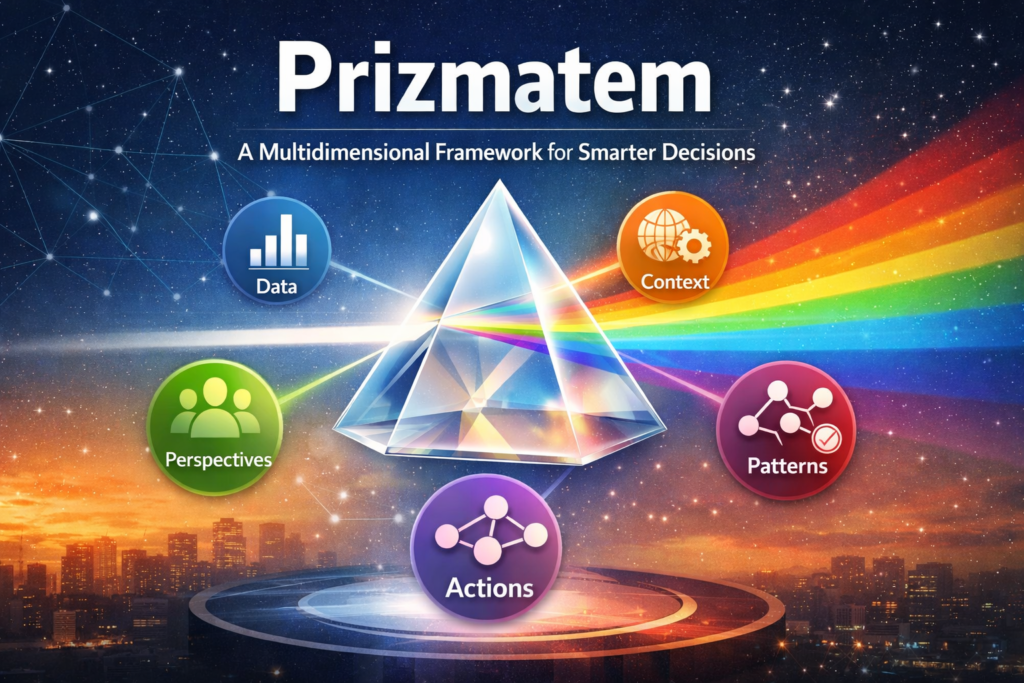

Today, we live in a world full of information. We see data, reports, opinions, and trends everywhere. But more information does not always mean better decisions. Many people and businesses feel confused, stressed, or stuck when facing complex problems,This is where Prizmatem comes in,Prizmatem is a simple but powerful thinking framework. It helps you break a complex problem into smaller parts, understand each part clearly, and then bring everything together to make a smart decision Frehf
What Is Prizmatem?
Prizmatem is a multidimensional thinking framework. This means it helps you look at a problem from different angles instead of only one.
The idea comes from a prism. When light passes through a prism, it splits into different colors. Each color shows part of the full light.
In the same way, Prizmatem helps you:
-
Break a problem into different parts
-
Study each part clearly
-
Connect the parts together
-
Take the right action
It is not:
-
Just a software tool
-
Just a business theory
-
Just a motivational idea
It is a clear and structured way of thinking.
Why Do We Need Prizmatem?
Many people use linear thinking. Linear thinking means:
-
See a problem
-
Find one cause
-
Apply one solution
But real-life problems are rarely that simple.
For example:
-
Sales drop may not only be about price.
-
Employee stress may not only be about workload.
-
Low website traffic may not only be about marketing.
Problems often have many causes. If you look at only one side, you may miss the real reason.
Prizmatem helps you avoid this mistake.
The Core Idea Behind Prizmatem
The core idea is simple:
Every complex problem has multiple dimensions.
Instead of asking only one question, Prizmatem encourages you to ask several clear questions.
This gives you better understanding and stronger decisions.
The Five Layers of Prizmatem
Prizmatem uses a five-layer model. Each layer focuses on a different part of the problem.
| Layer | What It Focuses On | Simple Question |
|---|---|---|
| Data Layer | Facts and numbers | What do we know? |
| Context Layer | Situation and environment | What is happening around it? |
| Perspective Layer | People and opinions | How do others see it? |
| Pattern Layer | Connections and causes | What links do we see? |
| Action Layer | Steps and solutions | What should we do? |
Let’s explain each layer in simple terms.
1. Data Layer – The Facts
This layer looks at clear information such as:
-
Sales numbers
-
Website traffic
-
Customer feedback scores
-
Deadlines
-
Budgets
This is the foundation. You start with facts, not guesses.
But facts alone are not enough.
2. Context Layer – The Situation
Now ask:
-
What is happening in the market?
-
Are there new competitors?
-
Has the economy changed?
-
Are customer needs changing?
Context explains why the data looks the way it does.
3. Perspective Layer – The Human Side
Different people see problems differently.
Think about:
-
Customers
-
Employees
-
Managers
-
Partners
Ask:
-
What do they believe is happening?
-
What are their concerns?
-
What are their expectations?
Understanding people helps avoid conflict and misunderstanding.
4. Pattern Layer – The Connections
Now connect everything.
Look for:
-
Repeated problems
-
Trends over time
-
Links between customer complaints and product features
-
Links between employee stress and deadlines
This is where real insight appears.
5. Action Layer – The Solution
After understanding everything, you decide:
-
What should we fix first?
-
What steps should we take?
-
How will we measure success?
Action should come after full understanding — not before.
How to Use Prizmatem Step by Step
Here is a simple process you can follow.
Step 1: Define the Problem Clearly
Instead of saying:
-
“Sales are bad.”
Say:
-
“Sales dropped 15% in the last 3 months among new customers.”
Be specific.
Step 2: Gather Data
Collect:
-
Numbers
-
Reports
-
Feedback
-
Observations
Do not rely on assumptions.
Step 3: Study the Context
Ask:
-
Has the market changed?
-
Did a competitor launch something new?
-
Are customer needs shifting?
Step 4: Understand Perspectives
Talk to:
-
Customers
-
Team members
-
Managers
Listen carefully.
Step 5: Find Patterns
Look for connections between:
-
Data and customer feedback
-
Market changes and sales drops
-
Team workload and performance
Step 6: Take Smart Action
Now create a plan based on everything you learned.
Where Can You Use Prizmatem?
Prizmatem works in many areas.
1. Business Strategy
You can use it to:
-
Plan growth
-
Reduce risks
-
Improve decision-making
-
Align departments
It helps leaders avoid one-sided thinking.
2. Marketing
Marketers can use Prizmatem to:
-
Understand customer behavior
-
Improve campaigns
-
Adjust pricing
-
Improve brand positioning
It connects numbers with customer psychology.
3. Product Development
Product teams can:
-
Study user feedback
-
Understand usage patterns
-
Improve onboarding
-
Increase customer retention
4. Personal Decision-Making
You can use it in daily life:
-
Career decisions
-
Financial planning
-
Relationship challenges
-
Goal setting
It helps you think calmly and clearly.
Prizmatem vs Traditional Thinking
Here is a simple comparison.
| Traditional Thinking | Prizmatem Thinking |
|---|---|
| Focus on one cause | Look at many dimensions |
| Quick reaction | Structured analysis |
| Short-term fix | Long-term clarity |
| Guess-based decisions | Fact-based decisions |
| Ignore perspectives | Include all viewpoints |
it reduces mistakes caused by rushed thinking.
Benefits of Using Prizmatem
People and businesses using this framework often see:
-
Clearer decisions
-
Fewer blind spots
-
Better teamwork
-
Improved innovation
-
Stronger long-term results
-
Less confusion
It builds smarter thinking habits over time.
Common Mistakes When Using Prizmatem
Avoid these errors:
-
Jumping to action too early
-
Ignoring stakeholder opinions
-
Relying only on data
-
Skipping pattern analysis
-
Not reviewing results later
it works best when all layers are used.
How to Start Using Prizmatem Today
You do not need special tools.
Daily Quick Practice
When facing a problem, ask:
-
What are the facts?
-
What is the situation?
-
How do others see it?
-
What patterns do I notice?
-
What action makes sense now?
This simple habit improves decision quality.
The Future of Prizmatem
As technology grows and information increases, problems will become more complex.
People and companies that think in multiple dimensions will:
-
Make smarter decisions
-
Adapt faster
-
Reduce risks
-
Stay competitive
it supports clear thinking in a complex world.
Frequently Asked Questions
1. Is Prizmatem a software tool?
No. it is a thinking framework. It can be used with or without software.
2. Is Prizmatem only for businesses?
No. It can be used by individuals, students, leaders, teams, and entrepreneurs.
3. How is Prizmatem different from normal problem-solving?
Normal problem-solving often looks at one cause.
it looks at multiple dimensions before taking action.
4. Does Prizmatem replace data analysis?
No. It includes data analysis but also adds context, human perspective, and pattern recognition.
5. Can small businesses use Prizmatem?
Yes. It works at any scale — from personal decisions to large companies.
6. Is Prizmatem related to artificial intelligence?
It can be used alongside AI systems, but it is not an AI tool itself. It helps humans interpret AI outputs more clearly.
7. Is Prizmatem difficult to learn?
No. The five-layer model is simple. With practice, it becomes natural.
Conclusion
Modern problems are complex. They involve data, people, context, and hidden patterns. Linear thinking is often not enough,it offers a clear and structured way to understand complexity,Prizmatem is not about overthinking,It is about thinking in a balanced and structured way,In a world full of noise, multidimensional clarity is a powerful advantage,And that is exactly what it provides.