
Today, many companies need to make products faster and cheaper. Traditional mold making can be slow and costly. It often takes many weeks to build a mold, and changing a design later can be expensive. This makes it hard for businesses to test new ideas and bring products to market quickly.
RepMold is a modern way to make molds. It uses digital design, computer testing, and modern machines to make molds faster and with less waste. RepMold helps companies move from idea to product more quickly and with better control over cost and quality.
This guide explains what RepMold is, how it works, where it is used, and how it is different from traditional mold making.
What Is RepMold?
RepMold is a digital and modern way to make molds for manufacturing.
Instead of making molds only by hand and trial and error, RepMold uses computers, software, and modern machines to design and build molds.
RepMold can mean:
-
A method for making molds in a faster way
-
A system of tools like CAD software, 3D printing, and CNC machines
-
A service offered by modern manufacturing companies
Main Features of RepMold
-
Uses digital design
-
Faster mold making
-
Easy to change designs
-
Less material waste
-
Good for testing and small production
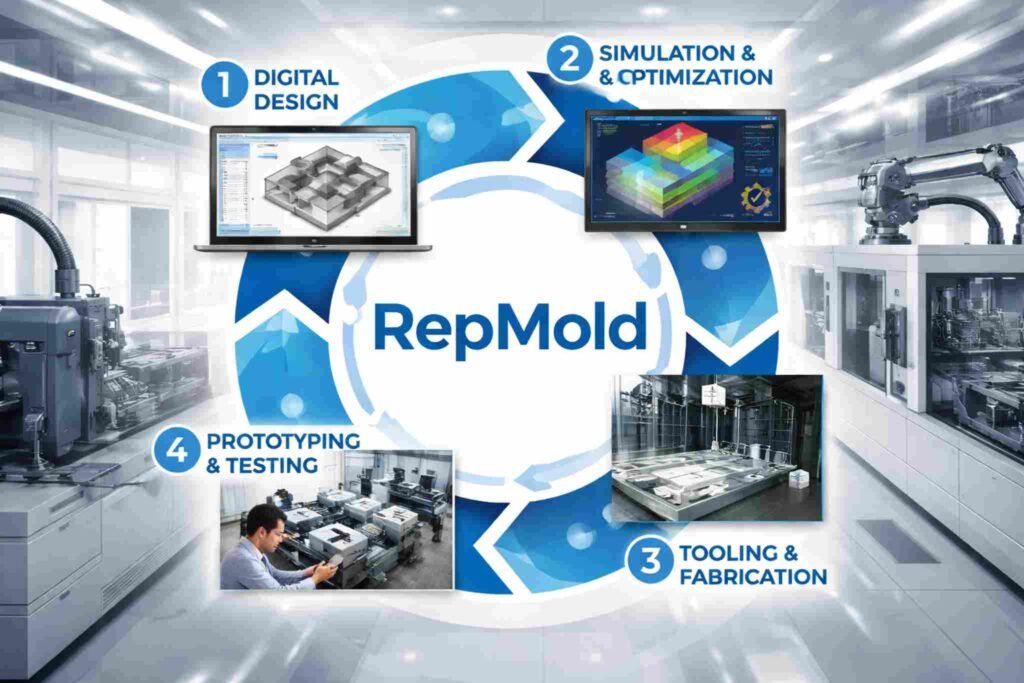
How RepMold Works (Step by Step)
RepMold follows a clear process from design to production.
Step 1: Digital Design
Engineers use computer software to design:
-
The product part
-
The mold shape
-
Cooling paths
-
Where the mold opens and closes
This helps avoid mistakes early.
Step 2: Computer Testing
Before making the mold, software is used to test:
-
How material flows in the mold
-
Where heat builds up
-
If the part may bend or shrink
This step saves time and money by finding problems early.
Step 3: Making the Mold
The mold is made using:
-
CNC machines for smooth and strong parts
-
3D printing for complex shapes inside the mold
This mix of machines helps make molds faster and more flexible.
Read also: MyFastBroker Com
Step 4: Testing the Mold
A small number of parts are made to check:
-
Fit
-
Size
-
Surface quality
If changes are needed, the design can be updated quickly.
Step 5: Production
After testing, the mold is used to make:
-
Small batches
-
Medium batches
-
Or early production parts
Read also: Oncepik
Tools and Technology Used in RepMold
RepMold uses several modern tools:
Main Tools
-
CAD design software
-
CNC machines
-
3D printers
-
Mold testing software
Extra Tools (Optional)
-
Computer simulations
-
Quality checking tools
-
Digital collaboration tools
RepMold vs Traditional Mold Making (Table)
| Feature | RepMold | Traditional Mold Making |
|---|---|---|
| Design Method | Computer-based | Mostly manual |
| Time to Make Mold | Fast (days or weeks) | Slow (weeks or months) |
| Cost to Start | Lower | Higher |
| Easy to Change Design | Yes | No |
| Good for Prototypes | Yes | Not ideal |
| Waste Material | Less | More |
| Best for | Prototypes, small batches | Large mass production |
Benefits of RepMold (Simple List)
RepMold offers many advantages:
-
Faster product development
-
Lower mold cost
-
Easy design changes
-
Better quality control
-
Less wasted material
-
Faster testing and improvement
-
Good for startups and new products
Where RepMold Is Used
Industries
RepMold is used in many industries:
-
Car industry – parts and testing
-
Medical devices – small precise parts
-
Electronics – cases and housings
-
Factories – tools and machine parts
-
Research labs – testing new designs
Common Uses
-
Making test parts
-
Small production runs
-
Trying new product designs
-
Making custom molds
RepMold for Prototyping
Prototyping means making test versions of a product. RepMold is very useful for this because:
-
Molds can be made quickly
-
Many design versions can be tested
-
Problems can be fixed early
-
Costs stay lower
Simple Prototyping Process:
-
Idea
-
Design on computer
-
Test with software
-
Make mold
-
Make test parts
-
Improve design
Environment and Waste Reduction
RepMold helps reduce waste and is better for the environment:
Environmental Benefits
-
Less scrap material
-
Fewer failed molds
-
Less energy used for rework
-
Better use of raw materials
Environment Comparison Table
| Factor | RepMold | Traditional Method |
|---|---|---|
| Material Waste | Low | High |
| Failed Molds | Few | More |
| Energy Use | Lower | Higher |
| Rework Needed | Less | More |
Limits of RepMold
RepMold is not perfect for every case.
When RepMold May Not Be the Best Choice:
-
Very large mass production (millions of parts)
-
Very hard steel molds needed for long use
-
Very high surface finish needed
-
Companies without digital tools or skills
Cost of RepMold (Simple Breakdown)
The cost of RepMold depends on:
-
How complex the part is
-
The size of the mold
-
The material used
-
How fast the mold is needed
-
How many parts will be made
Cost Comparison Table
| Cost Type | RepMold | Traditional Method |
|---|---|---|
| Starting Cost | Lower | Higher |
| Cost to Change Design | Low | High |
| Cost for Large Volume | Medium | Lower over time |
The Future of RepMold
RepMold is part of modern smart manufacturing. In the future, we may see:
-
More computer-designed molds
-
Faster automatic mold making
-
Better testing tools
-
Easier custom products
-
Smarter factories
How to Get Started with RepMold (Checklist)
Before starting a RepMold project:
-
✔ Prepare clear digital designs
-
✔ Decide how many parts you need
-
✔ Choose the right materials
-
✔ Work with skilled mold makers
-
✔ Plan time for testing and changes
Final Thoughts
RepMold is a modern and simple way to improve mold making. It helps companies make molds faster, reduce costs, and test ideas quickly. It is especially useful for new products, small production runs, and fast product development.
Traditional mold making is still useful for very large production. But for many modern businesses, RepMold offers a better and faster way to move from idea to real product.